-
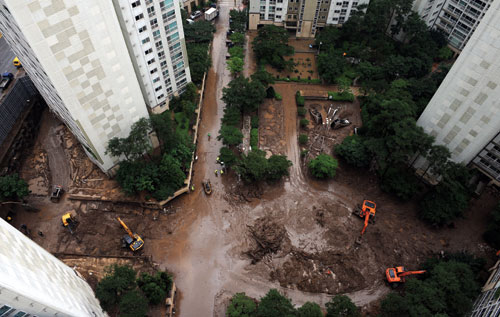
The long-awaited sunny skies appeared for a few hours during the weekend. Once again, grey clouds have shadowed the nation and the country is busy recovering from the series of landslides that were caused by destructive rainstorms.
In viewing the censuses, one can easily notice that the temperature on the Korean Peninsula has risen 1.8 degrees over the last 10 decades. Summer is 19 days longer than a century ago and winter has lost 17 days. Compared to the traditional rainy season, there is now more rain than the past. -
The results are simple and easy to comprehend. They are all signs of the beginning of a subtropical climate. The historic record of rainfall and climate change have given the country no choice than to start thinking about creating real changes in cities and how they deal with the weather. For starters, there is a strong need of a new water control system.
The current one in the nation’s cities is for a bygone climate. Environmental and architectural engineering must create new systems to control the drainage of rain and make sure the new water control system can keep cities safe. The current system’s capacity only allows to withstand 71 millimeters of rain every hour.
The recent torrential rains brought 100 millimeters of water, or more, every hour. It was a given equation that the system first designed in 1983 would create problems across the nation. The torrential rains brought 301.5 millimeters of rain in Seoul, setting an all-time record in the city since weather observations were first recorded in 1907.
National Institute of Meteorological Research국립기상연구소 announced a subtropical climate will arrive soon in Jeju Island’s coastal region and several areas in the southern coastal areas of Korea. The National Fisheries Research and Development Institute국립수산과학원 has proved that the ecosystem in South Korea is changing by announcing its discovery of subtropical coral and tropical fish near Oryuk Island off the coast of Busan.
In the past few days, the government has been busy to clean up the mess the rainfall has left, and it appears a team of civil engineers will be put together to create new drainpipes in big cities. Seoul city recently announced its plan to install 82.9 kilometers of drainpipes in 26 locations in the city by 2014. So far, only 5 kilometers have been completed.
새도시계획 시급
기다리고 기다리던 화창한 하늘이 주말에 잠깐 동안 나타났다. 다시 한번, 잿빛 구름이 한국을 뒤덮고 파괴적인 폭풍우로 인한 일종의 산사태를 복구하느라 바쁘다.
조사에 따르면, 한반도 기온이 지난 10년 보다 1.8도 상승했음을 누구나 쉽게 알 수 있다. 여름이 100년 전보다 19일 더 길어졌으며 겨울은 17일 더 짧아졌다. 기존의 장마철에 비해, 과거보다 지금이 비가 훨씬 많이 내린다.
그 결과는 간단하고 이해하기 쉽다. 이는 아열대 기후의 시작의 조짐이다. 폭우와 기후 변화의 역사적인 기록은 선택의 여지 없이 도시들의 실제 벌어지고 있는 변화를 파악하고 그 날씨에 어떻게 대처해야 할지에 대해 생각하게 만들었다. 먼저, 새로운 물 통제 시스템이 강력히 요구된다.
한국의 도시들이 현재 갖고 있는 시스템은 옛날의 기후에 대한 것이다. 환경건축고학은 비의 배수 시설을 통제할 새 시스템을 만들어야 하고 그 새 식수 통제 시스템이 도시들을 안전하게 유지할 수 있음이 분명하다. 현재 시스템의 용량은 시간당 비 71밀리미터를 견뎌낼 수 있을 정도이다.
최근 폭우는 시간당 100밀리미터 이상이었다. 1993년에 처음 설계된 그 시스템이 전국적으로 문제를 유발할 것이라는 것이 뻔한 상황이다. 날씨 관측이 1907년에 처음 기록된 이후 한국에 전대미문의 기록을 내면서, 서울에 폭우 301.5밀리미터가 내렸다,
국립기상연구소는 아열대 기후가 곧 제주도 지역과 국의 몇몇 남쪽 해안 지역들에 도착할 것이라고 한 발표했다. 국립수산과학원은 한국의 생태계가 부산 바다에서 떨어진 오륙도 근처에서 아열대 산호와 열대 물고기 발견을 발표함으로써 바뀌고 있음을 증명해 보였다.
지난 며칠 간, 정부는 폭우가 남긴 쓰레기를 깨끗이 치우느라 바빴고 토목기사들이 대도시에 새로운 배수관을 만들기 위해 힘을 합칠 것 같다. 서울시는 최근 2014년까지 26곳에 82.9km의 배수관을 설치할 계획을 발표했다. 현재, 겨우 5km이 완공되었다.
※틴타임즈 기사 제공 -
A New City Planning Is Needed