-
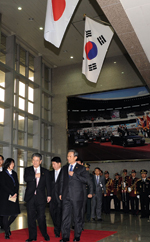
To bolster security ties between South Korea and Japan, the nation’s Defense Minister shook hands with his Japanese counterpart. Amid a strong call for a regional alliance framework from the U.S., the top military officials of the two nations recently sat down in Seoul to engage in a discussion.
The agreement was meaningful for it took place at a time when the U.S. Secretary of Defense is holding talks with Chinese ministers in Beijing to enhance bilateral military exchanges. According to the nation’s Ministry of National Defense the top headmen from both nations were able to reach a consensus on further strengthening military ties, although the two neighbors have had uneasy relations since Japan’s colonial rule of the Korean Peninsula for 35 years in the early 1900s.
In a public statement a spokesperson for the Ministry of National Defense국방부 said that the two defense chiefs uniformly agreed for stronger bilateral military ties for the peace and security of Northeast Asia. The statement further noted that the two chiefs are planning to push for the signing of the first-ever military pact between Seoul and Tokyo.
Although details of the discussion are unknown at this point, military officials assume the two nations will be sharing military information and exchanging military goods and services in the near future. The upcoming pact will call for a provision of supplies, including goods, fuel and all the components required for peace keeping, relief operations, as well as necessary military and rescue drills between the two countries’ navies. -
For the common good South Korea and Japan also agreed to exchange military information. It will allow each party to systematically swap intelligence on Pyongyang’s nuclear developments and weapons programs.
However, the nation’s Defense Minister, expressed his sensitivity about the deepening military relations due to lingering bitterness over Japan’s colonial past. Japan also showed caution as its actions may escalate military tensions on the Korean Peninsula and irritate China and North Korea over the intention of a military buildup.
Despite the concerns of the two, Washington has urged the Asian allies to quickly glue their military ties as security threats have grown in the region. It is unclear when North Korea’s armed provocations will take place again and Beijing continues to be reluctant to denounce Pyongyang. Therefore Tokyo’s pact will cement a strong unified position on the threat posed by North Korea.
Despite the pressures from the Asian community and the U.S., North Korea’s main regional ally, China is still refusing to condemn Pyongyang’s sinking of a South Korean frigate on March 26, 2010 and the North’s artillery bombing of Yeongpyeong Island in the West Sea on November 23 of last year.
한일 군수지원협정 체결
한국과 일본 간의 안보 관계를 강화하기 위해, 한국의 국방부 장관은 일본의 국방부 장관과 손을 잡았다. 미국으로부터 지역 동맹 체제를 강하게 요구하면서, 두 국가의 최고 군사 관계자들은 서울에서 열린 토론에 참여했다.
그 협정은 쌍방 군사 대화를 향상시키기 위해 미국 국방장관이 중국 국방장관과의 회담을 베이징에서 열고 있을 때 동시에 일어났기 때문에 의미가 있었다. 한국의 국방장관에 따르면 비록 두 이웃이 1900년 초에 35년 동안 일본의 한반도 식민지 지배 이후 불안한 관계를 맺고 있었지만, 두 국가의 대표자들은 더욱 강화된 군사 관계에 관한 합의에 도달할 수 있었다.
공동 성명에서 국방부 대변인은 두 국방 장관들이 평화와 북동 아시아의 안보에 대한 군사 관계를 더 강화하자는 데 한결같이 동의했다고 말했다. 뿐만 아니라 그 진술은 두 국방 장관들이 서울과 도쿄간 사상 최초의 군사 협정에 대한 서명을 추진할 계획이라고 언급했다. -
-
이 시점에서 그 토론의 세부적 내용들이 알려지지 않았지만, 군사 관계자들은 두 국가들이 머지 않아 군사 정보를 공유하고 군대 용품과 서비스를 교환할 것이라고 추측하고 있다. 다음 협정에서는 두 국가들의 해군들 간에 불가피한 군사 훈련과 구조 훈련뿐만 아니라 평화 유지, 구조 활동에 필요한 물품, 연료 그리고 모든 요소들을 포함하여, 보급품 공급을 요구할 예정이다.
공익을 위해 한국과 일본은 또한 군사 정보를 교환하는 데 동의했다. 그것은 평양의 핵 개발과 무기 프로그램에 체계적으로 정보를 바꾸도록 각 정당에 허용할 것이다.
하지만, 한국의 국방 장관은 일본의 식민지 과거에 대한 오래 지속된 비통함 때문에 깊어지는 군사 관계를 향한 민감함을 표현했다. 일본은 또한 그것의 조치에 대한 주의가 한반도에 대한 군사적 긴장감을 증가시킬지도 모르고 군사적 강화의 의도에 관해 중국과 북한을 짜증나게 할 지도 모른다는 것을 보여주었다.
두 국가간의 우려에도 불구하고, 워싱턴은 보안 위협이 그 지역에서 증가함에 따라 군사 관계를 신속히 맺도록 아시아 동맹을 촉구했다. 북한의 무장 도발이 다시 일어날지는 불분명하고 베이징이 계속해서 평양을 맹렬히 비난하기를 꺼리고 있다. 따라서 도쿄의 협정은 북한에 의해 제기된 위협에 대한 강하게 통합된 태도를 강화할 것이다.
아시아 사회와 미국의 압박에도 불구하고, 북한의 주된 지역 동맹국인, 중국은 2010년 3월 26일에 발생된 평양의 남한 구축함 침몰과 북한의 작년 11월 23일에 서해 연평도 대포폭격을 비난하는 것을 여전히 거부하고 있다.
※틴타임즈 기사 제공 -
Shaking Hands for Common Good