이벤트
A Historical Look at Burma’s Long Road to Democracy (버마의 머나먼 민주주의에 역사적인 시각)
2010/11/30 16:56:40
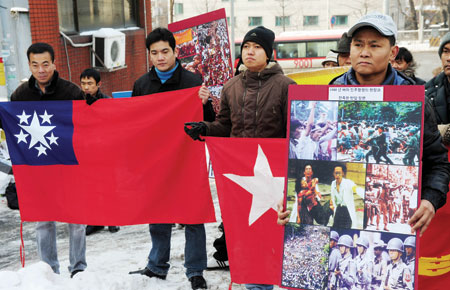
In 1057 King Anawrahta founded the first unified Burmese state with Buddhism as the main religion, yet in 1287 the Mongol empire under Kublai Khan conquered the nation. It would be around 250 years until the Toungoo dynasty reunited Burma with Portuguese help.
Various interactions with European powers followed, eventually resulting in Burma becoming part of the British Empire in 1886 and it remained as a British colony until 1942, when Japan invaded and occupied Burma with help from the Japanese-trained Burma Independence Army(who later fought against the Japanese).
In 1945 the U.K. liberated Burma from Japanese occupation with help from the AFPFL, which was led by Aung San(father of Aung San SuuKyi). However, Aung San was assassinated and by the time Burma became independent in 1948, U Nu, the former ruler under Japanese occupation, was made prime minister. A latter split in the AFPFL party resulted in the army Chief of Staff General Ne Win taking control temporarily.
Yet, despite U Nu’s party’s winning the next elections the military disagreed with their religious and separatist tolerance. In 1962, Gen. Ne Win led a military coup and took full control, abolishing the federal system, forming a single-party state and banning independent newspapers. The military dictatorship began at this point.
While all opposition was forbidden the Opposition National Democratic Front was formed in 1975 and began its guerrilla insurgencies. However, the currency devaluation of 1988 wiped out many people’s savings, triggering widespread anti-government riots. Thousands of people were killed and imprisoned over the following year. Among those imprisoned was the daughter of Aung San, National League for Democracy(NLD) leader Aung San SuuKyi.
In 1990 the NLD won a landslide victory in the general election, but the military ignored the result and maintained power. Nevertheless the imprisoned leader was awarded the Nobel Peace Prize for her commitment to peaceful change in 1991. The following decade saw the military government continuing to clamp down on democracy campaigners while ignoring calls for democracy from foreign leaders. However in 2000, the government lifted restrictions on the movements of Aung San SuuKyi and senior NLD members, while releasing some 200 pro-democracy activists. Unfortunately this freedom was short lived as SuuKyi was taken back into custody three years later.
The rest of the 2000s saw the government suggesting democracy but making no hard moves to achieve it with opposition groups being left out of the talks. Indeed the recent elections saw the NLD boycotting the polls and unsurprisingly the military-backed Union Solidarity and Development Party (USDP) won a major victory. However, shortly afterwards SuuKyi was released from house arrest with promises that a definite move towards democracy would take place.
Looking back over the Burmese nation’s complicated past it seems hard to give much hope for SuuKyi’s freedom lasting any amount of time and it is debatable whether any change can actually be achieved. Nevertheless there is always the chance that this could be the time that something actually sticks and real change is made. After looking over almost 1000 years of difficult history what do you think the chances are for freedom in Burma?
버마의 머나먼 민주주의에 역사적인 시각
최근 버마에서의 허위 선거와 민주당 대변인 아웅산 수지의 깜짝 발표가 민주주의와 자유 버마의 가능성에 대해 세계와 상반되는 메시지를 전했다. 하지만, 많은 국가들처럼 버마는 솔직하지 못하고 많은 사건들이 버마 사람들은 현재 스스로 찾고 있는 분위기를 조성한 책임이 있다. 이는 세계 다른 나라들과 민주주의의 요청에 맞서 밀고 당기고 있는 군사 독재 정부에 의해 통치된다. 진실은, 버마의 자유를 향한 길이 많은 사람들이 예상하는 것보다 더 길어졌다.
1057년에 아나우라타 왕이 주된 종교였던 불교와 함께 처음 통합된 버마 국가를 설립했다. 하지만 1287년에 쿠빌라이 칸 하의 몽고 제국이 버마를 정복했다. 퉁구왕조가 포르투갈의 도움으로 버마를 재통합하기까지 약 250년이 걸렸다.
유럽 권력과의 다양한 상호작용이 이어져, 결국 버마가 1886년에 영국 제국의 일부가 되는 결과를 낳았다. 1942년까지 영국 식민지로 남아있게 됐는데, 그 때 일본이 침략하여 일본에서 훈련 받은 버마 독립당의 도움으로 버마를 차지했다(그들은 후에 일본인과 투쟁했다).
